Case Details: Union of India vs. Torrent Power Ltd. (2026) 39 Centax 265 (S.C.)
Judiciary and Counsel Details
- Sanjay Kumar & K. Vinod Chandran, JJ.
- S/Shri S. Dwarakanath, A.S.G., Gurmeet Singh Makker, AOR, Sarthak Karol, Digvijay Dam, Ms Divya Jyoti Singh, Raghav Sharma, Rajat Vishnaw, S. Vijay Adithya, Mudit Bansal, Prabhakar Yadav & Abhyudey Kabra, Advs., for the Petitioner.
- S/Shri V. Lakshmikumaran, Ms Nitum Jain, Ms Neha Choudhary, Ms Medha Sinha, Swastik Mishra, Advs. & Ms Charanya Lakshmikumaran, AOR, for the Respondent.
Facts of the Case
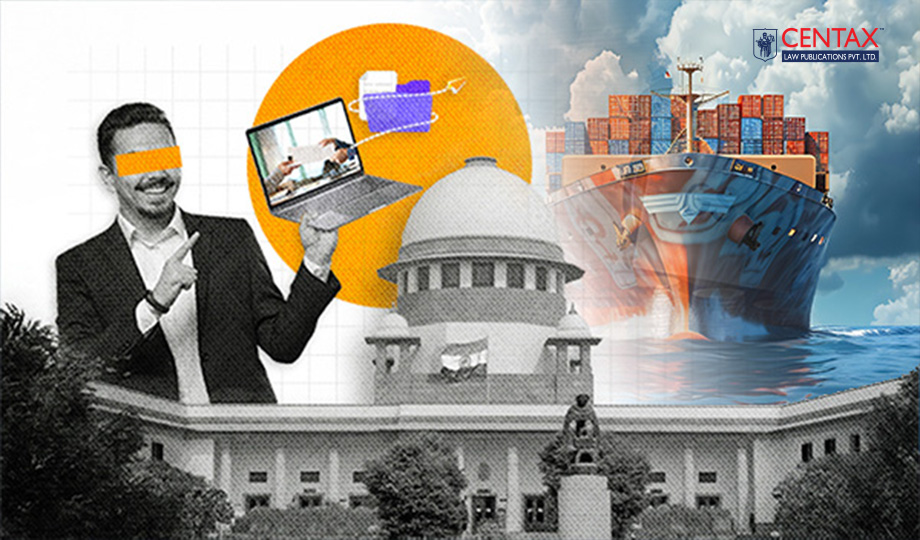
The assessee, engaged in electricity generation and distribution, had imported natural gas on a CIF (Cost, Insurance, and Freight) basis and paid IGST and Service Tax on ocean freight under the reverse charge mechanism as per Notification No. 10/2017-I.T. (Rate) dated 28-06-2017 and the Finance Act, 1994. Following the Supreme Court ruling in Mohit Minerals (P.) Ltd. [2022 (61) G.S.T.L. 257 (S.C.)], which declared the levy on ocean freight unconstitutional, the assessee filed refund applications before the authorities. In response, the authorities issued a show-cause notice to the assessee proposing to reject such a refund. The assessee, in its reply, proposed that the refunded amount be deposited in a separate account and the benefit passed on to consumers through tariff adjustments approved by the Gujarat Electricity Regulatory Commission (GERC). The authorities rejected the assessee’s contention and consequently rejected the refund applications. Aggrieved, the assessee filed a special civil appeal before the High Court, which allowed the refund claim and accepted the assessee’s proposal for passing the benefit to consumers through tariff adjustments. The matter was thereafter placed before the Supreme Court on appeal by the department against the High Court order.
Supreme Court Held
The Supreme Court held that under Section 54 of CGST Act, the officer must verify whether the claimed refund is actually refundable, and any amount so determined is to be credited to the Consumer Welfare Fund (CWF) as referred to in Section 57, except in cases covered under Section 54(8)(e) where the tax incidence has not been passed to any other person. In the present case, it was an admitted fact that the petitioner had passed on the tax burden to consumers, and therefore, the exception under Section 54(8)(e) did not apply. The Court observed that any procedure to directly refund the amount to consumers, as proposed by the High Court or assessee, was not contemplated by the statute. Consequently, the assessee was directed to transfer the refundable amount to the authorities to be credited to CWF, and the appeal was allowed in favour of the department.
List of Cases Reviewed
- Torrent Power Ltd. v. Union of India — (2025) 26 Centax 409 (Guj.) = 2025 (95) G.S.T.L. 437 (Guj.) — Reversed [Paras 2, 11]
List of Cases Cited
- Mohit Minerals Pvt. Ltd. v. Union of India — 2020 (33) G.S.T.L. 321 (Guj.) — Referred [Para 3]
- Union of India v. Mohit Minerals Private Limited — 2022 (61) G.S.T.L. 257 (S.C.) — Referred [Para 3]
List of Notifications Cited
- Notification No. 10/2017-Integrated Tax (Rate), dated 28-6-2017