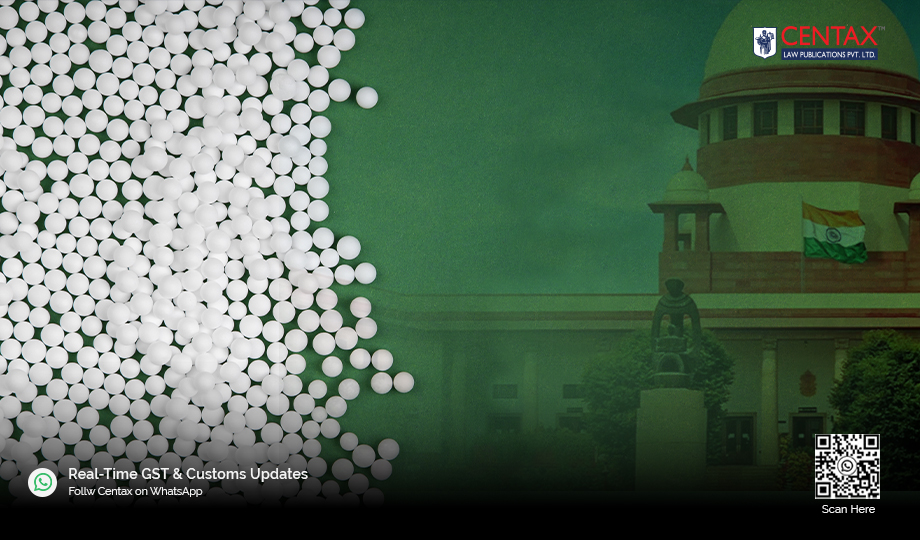
Case Details: Commissioner of Customs (Port), Kolkata vs. Surabhi Enterprises Pvt. Ltd. (2026) 40 Centax 174 (S.C.)
Judiciary and Counsel Details
- Aravind Kumar & Prasanna B. Varale, JJ.
- S/Shri. N. Venkataraman, A.S.G. Rajeev Ranjan, Ms Pankhuri Shrivastva, Kamal Digpaul & Ms Agrima Singh, Advocates & Gurmeet Singh Makker, AOR, for the Appellant.
- Ms Neha Choudhary, Ms Nitum Jain, Ms Medha Sinha & Swastik Mishra, Advocates & Ms Charanya Lakshmikumaran, AOR, for the Respondent.
Facts of the Case
The appellant imported Poly Vinyl Chloride resin of suspension grade and classified the goods under Customs Tariff Item 3904 21 10, availing concessional basic duty under the applicable tariff entry. The department initiated proceedings seeking reclassification of the goods under the residuary Customs Tariff Item 3904 10 90 on the basis of test reports obtained from CIPET, contending that the classification adopted by the appellant was incorrect. The appellant submitted that the goods were appropriately classifiable under the specific tariff entry and relied upon Rule 3(a) of the General Rules for Interpretation of the Import Tariff Schedule to assert that a specific entry would prevail over a general or residual entry. The Customs, Excise and Service Tax Appellate Tribunal (CESTAT) examined the material on record and accepted the contention of the appellant, holding that the classification under the specific tariff entry was correct and setting aside the consequential demands, penalties, and confiscation ordered by the department. The matter was accordingly placed before the Supreme Court.
Supreme Court Held
The Hon’ble Supreme Court held that there were no grounds to interfere with the order passed by the Customs, Excise and Service Tax Appellate Tribunal (CESTAT). It was observed that CESTAT had rightly upheld the classification of the goods under the specific Customs Tariff Item as claimed by the appellant. The Court noted that the view taken by CESTAT in preferring the specific entry over the residuary entry was in accordance with the applicable principles of tariff interpretation. It further found that the findings recorded by CESTAT did not suffer from any legal infirmity warranting interference. Accordingly, the appeal was dismissed.
List of Cases Reviewed
- Surabhi Enterprises Pvt. Ltd. v. Commissioner — (2025) 37 Centax 218 (Tri. – Kolkata) — Affirmed [Para 2]